

Neither an Isolationist nor a Neocon

Rather than a departure from standard practice, recent actions by the United States continue its longstanding commitment to protect vulnerable religious communities
By Michael Oren
President Trump’s decision to intervene militarily to defend Christians from ISIS attacks in Nigeria has been criticized by left and the right-wing commentators alike. Progressives denounced the operation as the product of intense lobbying by Evangelicals and a sharp departure from America’s traditionally secular foreign policy. A burgeoning school within MAGA, meanwhile, has portrayed any overseas action by Trump as a betrayal of his America First pledge. Yet both sides are wrong. Rather than a departure from standard practice, Trump’s action represents the continuation of America’s longstanding commitment to protect vulnerable religious communities abroad. Instead of favoring foreign over domestic affairs, the president has determined that standing up for the innocent and powerless is a fundamental American interest.
History proffers many precedents for Trump’s policy. For example, as I wrote in my book Power, Faith, and Fantasy, after Bedouin marauders attacked it in 1857, President James Buchanan provided guns and ammunition to a colony of American Christians living in Ottoman-ruled Palestine. A year later, the colony, which had only recently hosted Moby Dick author Herman Melville, was again ravaged. Its founder, Walter Dickson, a missionary from Groton, Massachusetts, was killed and his wife and daughter repeatedly raped. Washington dispatched its consul-general in Egypt to pressure the Ottoman authorities “to safeguard the unprotected heads of Jews and Christians in Palestine,” and a warship, the USS Macedonian, to patrol Palestine’s coast. Coincidentally, both the consul and the Macedonian’s captain were American Jews who viewed the protection of Christians as their patriotic duty.
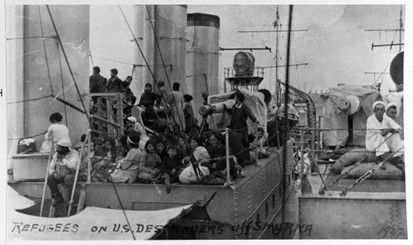
Yet not only American Christians were saved. In response to the Turks’ slaughter of Armenian Christians in 1900, President McKinley ordered the USS Kentucky to demonstrate off Istanbul. “If these massacres continue,” Captain “Red Bill” Kirkland swore, “I’ll be swuzzled if I won’t… hammer a few Turkish towns.” In 1915, President Woodrow Wilson sent two destroyers to evacuate thousands of Jews from Palestine who, fearing the Armenians’ fate, were threatened with genocide by the Turks. Among those rescued was Israel’s founding father, David Ben-Gurion. President Harding also deployed warships to evacuate Greek Christians from embattled Smyrna—today’s Izmir—in 1922. In fighting ISIS between 2013 and 2016, President Obama cited America’s responsibility to protect “religious minorities, including Christians and Yezidis,” to whom “these terrorists have been especially barbaric.”
None of these initiatives, it must be emphasized, resulted in a large-scale war or even an asymmetrical military conflict. American forces completed their mission, often without sustaining casualties, while demonstrating impressive operational abilities and professional prowess. By coming to the aid of one community at risk, the U.S. gained the goodwill of other beleaguered peoples worldwide.
For many of Trump’s predecessors, the pursuit of faith-based goals never represented the abandonment of practical foreign policies, nor did it mean putting America second. On the contrary, generations of decision-makers viewed support for threatened religious and ethnic groups abroad as a sacred obligation, a reflection of the American brand. No isolationists, these leaders were realists for whom the flexing of American muscles on issues grounded in core national values was a means of strengthening the country’s self-respect as well as its global position. But neither were they neocons striving to remake foreign societies in America’s image. They solely sought to show the world just who the American people were and what they stood for.
Though analysts have debated the efficacy of roughly a dozen Tomahawk missiles fired by the U.S. Navy at ISIS targets in Nigeria, the very fact of the operation sent an unequivocal message about American resolve. President Trump established a clear red line to ISIS and other terrorists who might consider crossing it. Similarly, the massive military aid provided by both the Trump and Biden administrations during the recent war to Israel, and the active participation of U.S. forces in its defense, cemented America’s image as a dependable ally that is willing to support—and, if necessary, fight for—its friends.
By defending minorities beyond its shores, the White House has upheld a time-honored American tradition. In coming to the aid of Nigerian Christians, President Trump is not diverging from established U.S. foreign policy but restoring its original values. In extending a firm hand to those most in need, the United States is putting America—its interests and its ideas—first.


Comentarios